
Selling Greece's 'Impossible' Wellness Retreats
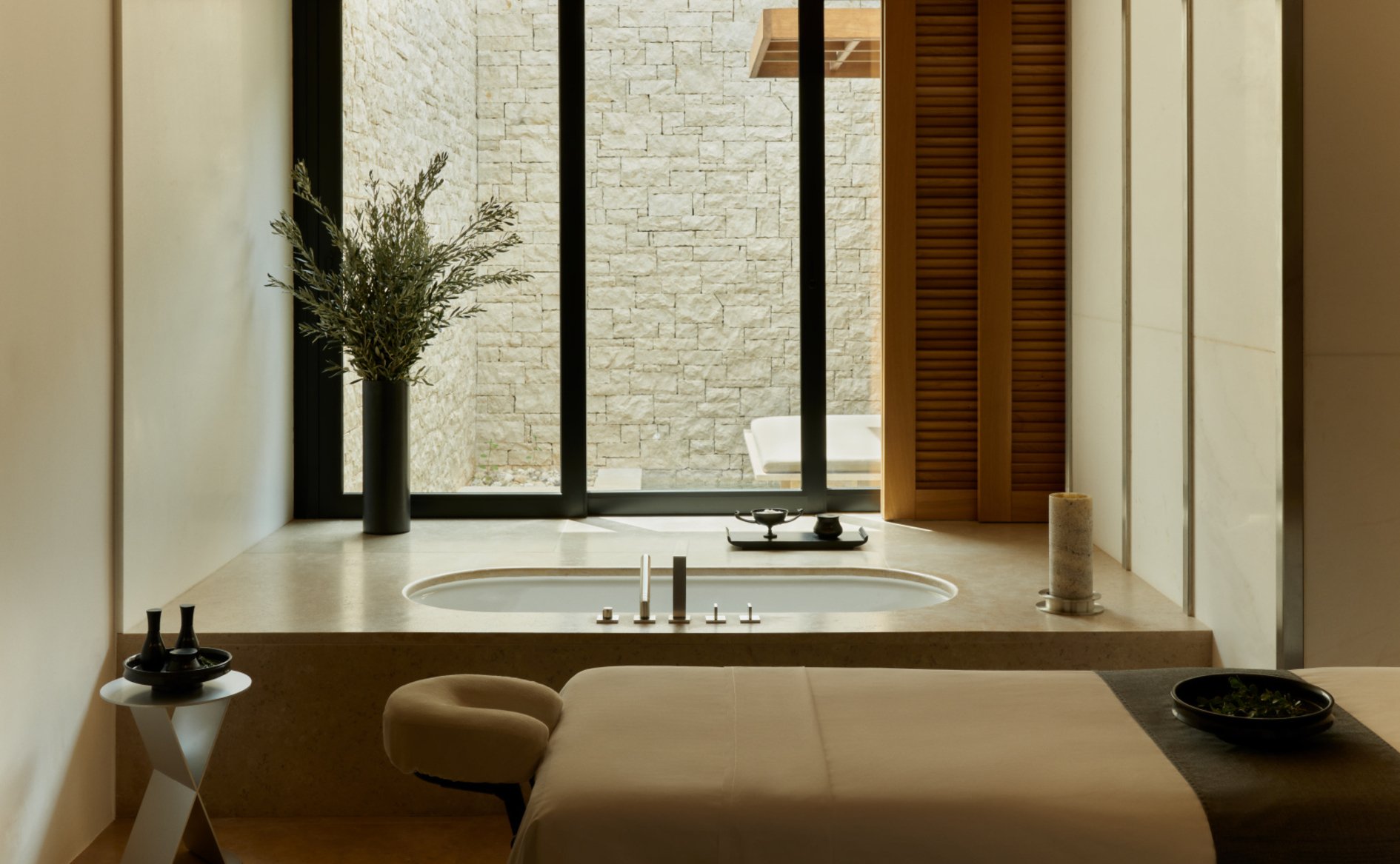
Somewhere on the pine-covered slopes of Mount Taygetus in the Peloponnese, beside the Byzantine ruins of Mystras, there is a swimming pool that looks like it landed from another world. At Euphoria Retreat, the centrepiece of one of Europe's largest spas is a domed hydrotherapy sphere — a cocoon of stone and sound, half spaceship and half ancient temple, where guests float to a soundtrack of marine noise before swimming out through an archway to an open-air pool overlooking the valley.
It is the kind of place your clients now ask for by description rather than name: "somewhere remote, somewhere extraordinary, somewhere that doesn't feel like a hotel at all." The demand for these otherworldly wellness retreats has never been higher. The problem, for the travel advisor, has never been the dream. It has always been the logistics.
The market has already moved toward the extraordinary
Wellness is no longer a spa add-on at the end of a beach holiday. It has become the reason for the trip. High-net-worth travellers are booking program-led stays built around longevity, detox, metabolic testing, and genuine transformation — and they are willing to travel far off the obvious map to find them.
Greece illustrates the shift perfectly. A retreat like Euphoria sits roughly 250 kilometres from Athens, closer to a regional airport than the capital, woven into a UNESCO World Heritage landscape and built on a philosophy that blends ancient Hellenic medicine with Traditional Chinese practice. The remoteness is not a flaw in the product. The remoteness is the product. Clients are paying precisely because it feels unreachable.
That is wonderful for desire and difficult for delivery. The same isolation that makes a retreat feel impossible to reach makes it genuinely complicated to operate. And that gap — between what sells beautifully and what executes reliably — is exactly where many advisors quietly lose money, or lose clients.
Why "impossible" retreats break ordinary supply chains
A city hotel is forgiving. There are taxis, backup vendors, and a concierge desk that has solved every problem a thousand times. A remote wellness retreat in the mountains is not forgiving at all.
Consider what actually has to happen for a single VIP booking at a place like this to feel effortless. Someone has to coordinate the long transfer from a regional airport, often over winding rural roads, and time it to the client's flight rather than a generic schedule. Someone has to confirm the specific program, the dietary protocol, the treatment sequence, and the room category with a property whose entire model is bespoke. Someone has to be reachable, locally, when a flight slips, a preference changes, or a client decides at the last moment to extend.
For an advisor sitting in another country, none of that is controllable from a desk. You can email the property. You cannot stand in the arrivals hall. You cannot call a driver you have personally vetted, or lean on a relationship with a local supplier built over years. When something goes wrong in a remote destination, distance turns a small hiccup into a ruined trip — and the client remembers who they booked with.
The operational engine behind the dream

This is the difference between a tour operator and a destination management company. A DMC is not a booking channel; it is the on-the-ground operational engine that turns an itinerary into a lived experience. It holds the local supplier relationships, the vetted transport, the language, the cultural fluency, and the round-the-clock presence that a remote retreat demands.
Hyperport DMC describes its role exactly this way: the operational engine and the local ground teams that make the impossible retreat real for your brand. The advisor designs and sells the journey. The DMC absorbs the part that does not scale from a distance — the transfers, the supplier coordination, the contingencies, the quiet work of making a four-hour-from-anywhere sanctuary feel as seamless as a downtown suite.
The phrase that matters here is for your brand. A good ground partner operates invisibly. The client experiences flawless logistics and credits the advisor who recommended the retreat. The DMC's name never needs to appear. You sell the dream; the dream simply works.
Stop selling the headache, start selling the dream
There is a subtle trap many advisors fall into with extraordinary destinations. Because the logistics are hard, they unconsciously talk clients out of the harder, more remote, more profitable options — steering toward the safe, easy-to-operate property because it is the one they know they can deliver without stress.
That instinct quietly caps the value of the business. The most desirable wellness retreats are also the highest-margin, most loyalty-building trips an advisor can sell. Declining them because of operational risk means leaving the best clients and the best revenue on the table.
Removing the operational risk changes the calculation entirely. When the ground execution is handled by a partner whose whole business is execution, the advisor is free to say yes to the spectacular. The remote sphere pool in the mountains stops being a logistical liability and becomes exactly what it should be: a story the client will tell for years, booked through you.
One inquiry, a global office behind it
The other quiet advantage is reach. Wellness tourism is global and scattered by nature — the most compelling retreats are rarely clustered in convenient hubs. Building reliable ground capability in each of those destinations, one supplier at a time, is not realistic for an individual agency.
A networked DMC functions as a global operations office the advisor does not have to build or staff. Instead of sourcing and vetting a new local operator for every remote retreat, the advisor forwards the inquiry to a single partner who already holds the relationships — in Greece and far beyond. As Hyperport DMC frames it: forward your next inquiry and watch the ground team work. Your global office is ready.
For the advisor, that is the whole proposition in one line. Keep the client relationship, keep the creative work of designing the journey, keep the margin — and hand the part that breaks at a distance to a partner built to handle it.

The takeaway for advisors
Your clients are already dreaming about the spa that feels like another planet. They want the sphere in the mountains, the retreat that takes effort to reach, the experience that proves they went somewhere few people ever do. The desire is not the hard part.
The hard part is making the remote feel effortless — and that is precisely what a specialist ground partner exists to do. Sell the dream with confidence. Let the operational engine make it real.
Working on a wellness itinerary in Greece or another hard-to-reach destination? Forward the inquiry to Hyperport DMC and let the ground team handle the rest.
